GraphGuard IoT
An interactive benchmark of how well graph neural networks that find compromised IoT devices (botnets) hold up under attack.
graphguard-iot.vercel.app
WHAT IT DOES
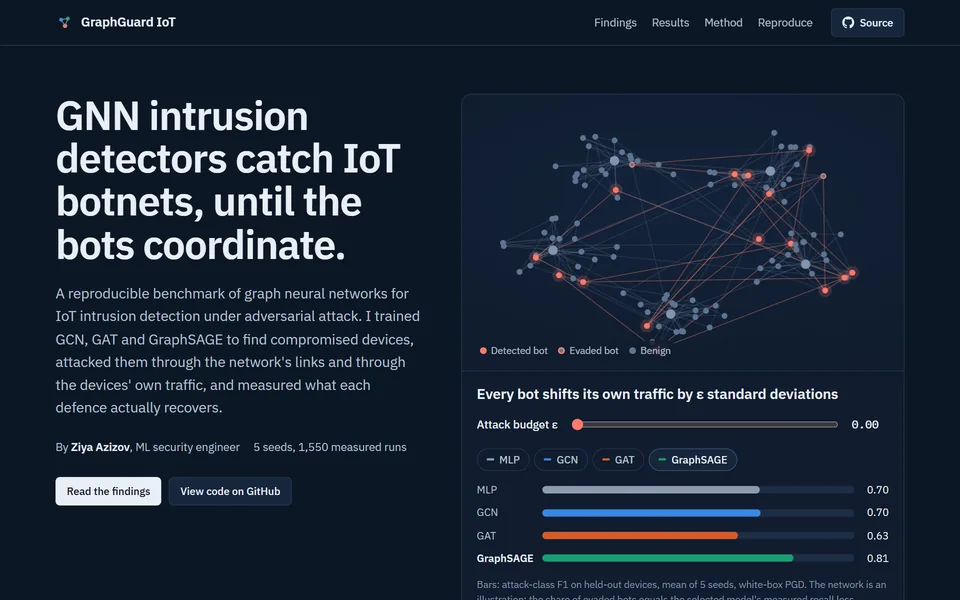
Thousands of IoT devices talk to each other in smart homes and factories. When one is compromised, graph neural networks (GNNs) are used to find it. This project measures how well those detectors hold up under attack.
GCN, GAT and GraphSAGE were trained on a 1,500-device IoT network, then attacked in two ways: by rewiring links (gradient and DICE attacks) and by bots shifting their own traffic (PGD). DropEdge, cosine pruning and adversarial training are compared as defences.
The site is interactive: drag the attack budget and watch each model degrade. 5 seeds, every number reproducible with one command.
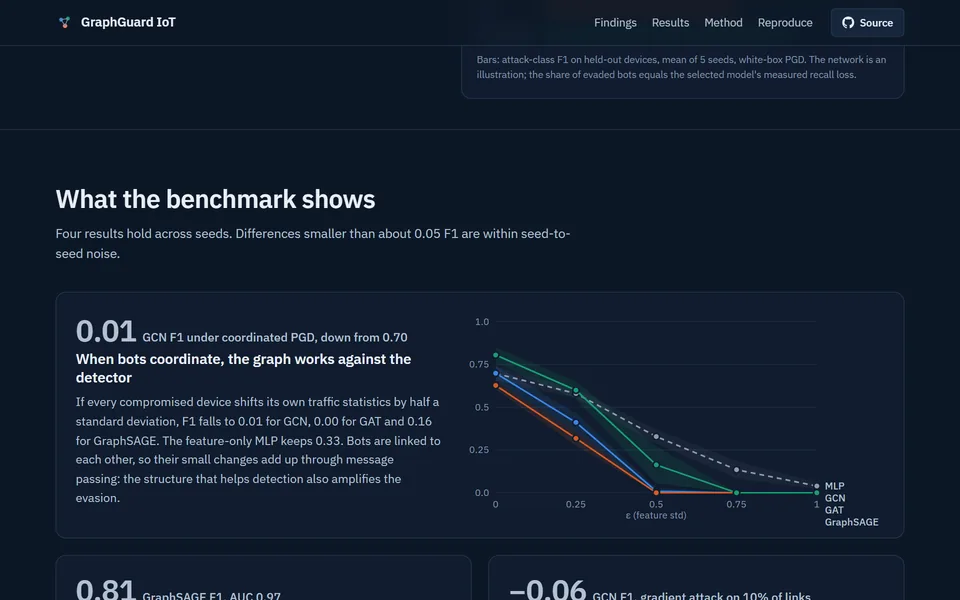
0.70→0.01
GCN F1 when the bots coordinate.
HIGHLIGHTS
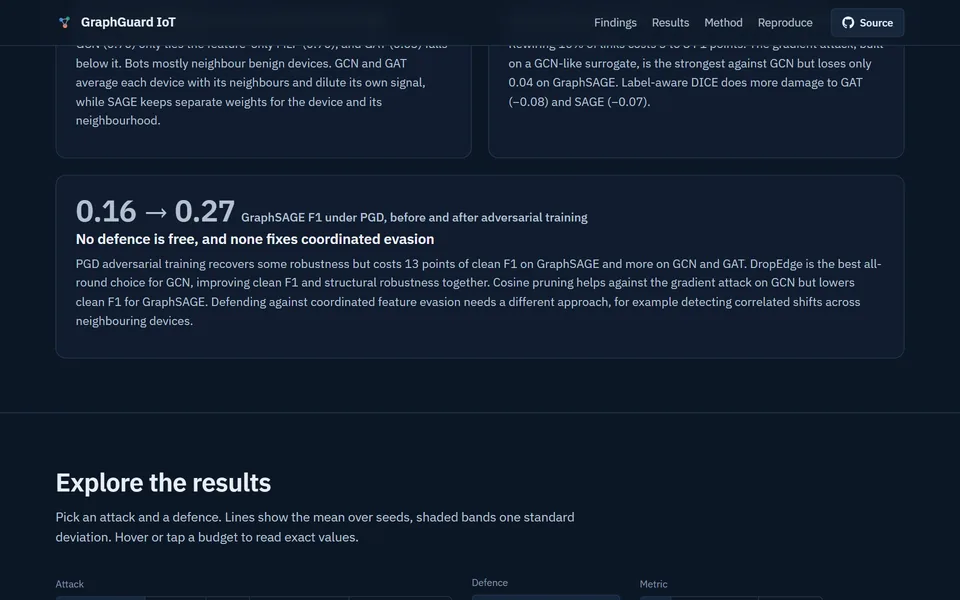
- Only GraphSAGE gets real value from the graph (F1 0.81, AUC 0.97).
- Structural attacks cost 3–8 F1 points.
- No defence is free, and none fixes coordinated evasion.